Flexopodz / Mounting Room Systems · EST. 2019 · Made in USA
TriPODZ™
Three carts. / One press. / Zero mounting-room wait.
Press performance is easy to measure. The mounting-room handoff is not, and it is where press ROI quietly leaks. TriPODZ is the narrow-web answer: three carts per press, two staged at the deck for makeready, one waiting to catch wet tooling. The press never waits on the mounting room.
DOC
FPZ-TRI-001
REV
2026.05
SCOPE
NARROW WEB
SYSTEM
3-CART ROTATION
Every component for one job, staged on one cart.
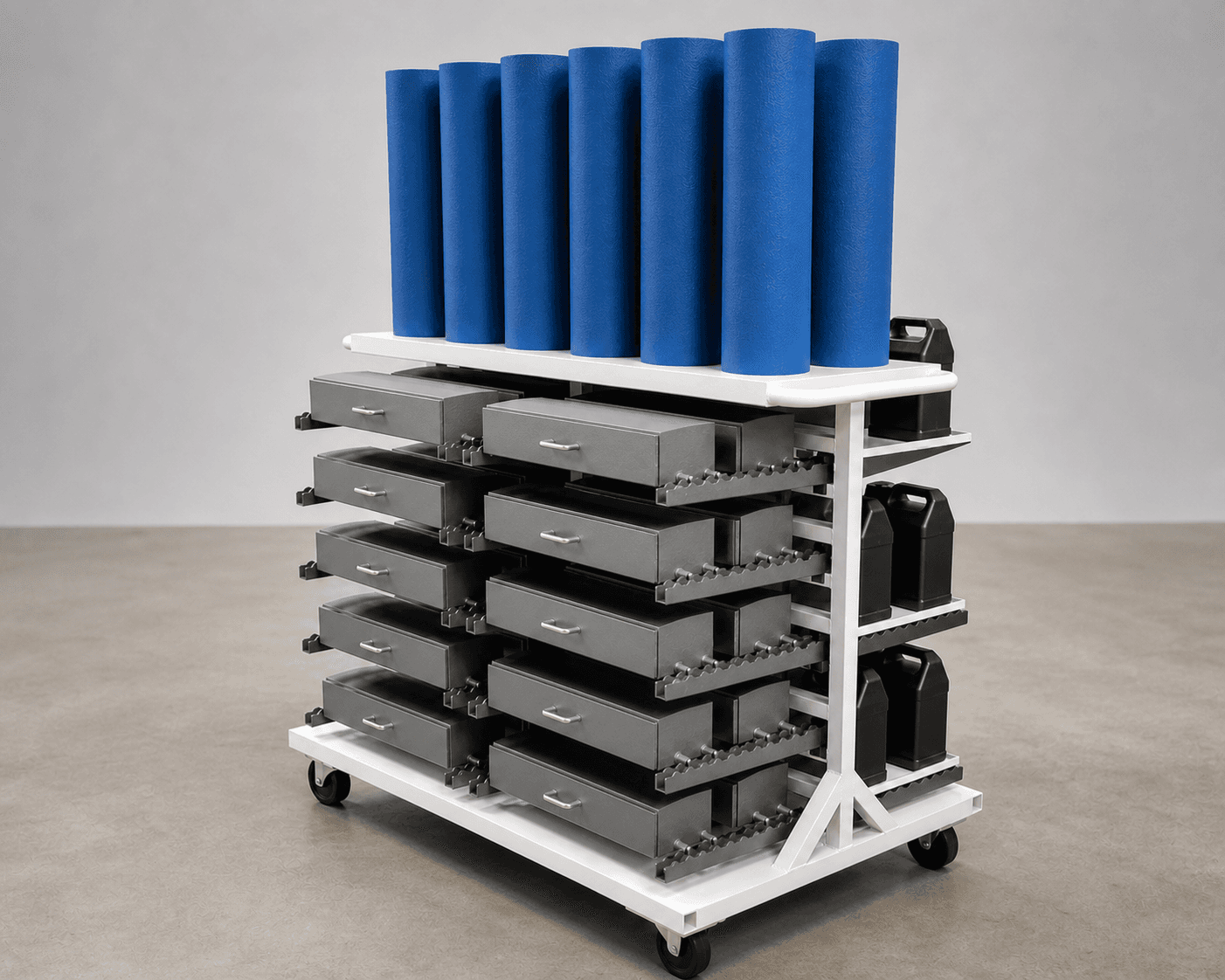
Every component for one job, staged on one cart. Plates pre-mounted to sleeves. Chambers pre-loaded with ink and doctor blades. Shelves double as drip trays. Shelf supports double as anilox and chamber racks. Nothing is searched for at press-side.
Mounted sleeves
Plates can be mounted to sleeves before the cart rolls to the press.
Ink chambers
Chambered doctor blade assemblies stay with the job instead of being hunted down at press-side.
Ink jugs
Job-specific ink can ride with the sleeves, chambers, and anilox plan.
Anilox storage
Adjustable supports create a clean place for rollers or chambers.
Mobile base
Casters let the same cart move between mounting, press, cleanup, and storage.
Drip tray shelves
Shelves help contain the messy part of changeover instead of spreading it across the floor.
x10
Mounted sleeves
x10
Ink chambers
x10
Ink jugs
x10
Anilox rollers
Two carts staged for makeready. One catching wet tooling.
Each press has three TriPODZ carts assigned to it. Carts A and B are prepared in the mounting room, checked, and rolled out to the press deck. Cart C waits at the press as the go-back cart for wet tooling coming off press during changeover.
Cart A
Current job
One cart carries the components needed for the job being set up or changed over now.
Cart B
Next job
A second cart can be prepared while the press is still running, so the next makeready is staged before the stop.
Cart C
Go-back cart
A third cart can collect wet sleeves, used chambers, ink, and anilox rollers so cleanup has a defined return path.
// The TriPODZ Multiplier
Three carts
per press.
Always.
The rotation is what makes TriPODZ work. One on-press, one on-deck, one in the return loop. The pattern scales across every press on the floor.
3
carts per press
6-12
presses per plant
18-36
carts in rotation
What mounting-room delay is costing the industry.
TriPODZ applies SMED, Single-Minute Exchange of Die, to the narrow-web mounting room. Pre-mounted sleeves, pre-loaded ink chambers, staged ink, and anilox planning move out of stopped-press time.
32%
Average narrow-web press downtime, with an average of six changeovers per press per day.
SRC · LPC, Inc. survey
45-90 min
Typical narrow-web flexo changeover duration, much of it spent fetching, mounting, and staging tooling at press-side.
SRC · Industry survey data
3-8%
Makeready waste as a percentage of total substrate consumption per job, listed in the guide as a published FTA benchmark.
SRC · FTA benchmark
35-45%
Typical Overall Equipment Effectiveness at North American label converting plants.
SRC · TLMI / Mark Andy
// The SMED Framework · Shigeo Shingo, Toyota Production System
Convert internal setup to external.
SMED reduces changeover time by moving work done while the press is stopped to work done while the press is still running. TriPODZ moves plate mounting, ink loading, chamber prep, and anilox staging entirely off the press deck and into the mounting room.
The guide cites published SMED implementations delivering 45-75% changeover-time reduction by converting internal to external setup.
These are industry averages. Your number is different. A Flexopodz onsite diagnosis quantifies the cost of the current setup with source-tagged line items and delivers a written investment justification memo.
Apply a 30% makeready reduction. Add one job per shift. Per press.
A conservative scenario below the published SMED reduction range cited in the guide. Inputs are documented so the math can be tested against a plant's actuals.
Shift
8 hr
480 min
Avg Changeover
60 min
FTA mid-range
Avg Run Length
60 min
short-run label
Reduction Applied
-30%
changeover only
Baseline
Today
4 changeovers x 60 min
4
Jobs / Shift
With TriPODZ
-30% Makeready
5 changeovers x 42 min
5
Jobs / Shift
// The Compounding Effect
One extra job per shift compounds across the plant.
+1 job
per press per shift
+25% throughput
+3 jobs
per press per day
3-shift operation
+750 jobs
per press per year
250 production days
+4,500 jobs
per year on a six-press floor
zero additional capex
// The Flexopodz Framework
Capacity. Capital. Risk.
One model. One readout.
01 · Capacity
Productive hours trapped before makeready.
TriPODZ moves retrieval, mounting, and staging entirely off the press deck, recovering hours the investment case already paid for.
02 · Capital
Floor space and assets doing the wrong job.
Defensive staging, duplicate storage, and crowded press-side carts absorb capital that should be producing margin. Three carts. One job each.
03 · Risk
Workarounds leadership cannot see.
When the right sleeve, plate, anilox, or chamber depends on tribal knowledge, the plant carries preventable quality and continuity risk.
Doing nothing is the most expensive option.
A 30-minute discovery call quantifies your number.