About Flexopodz
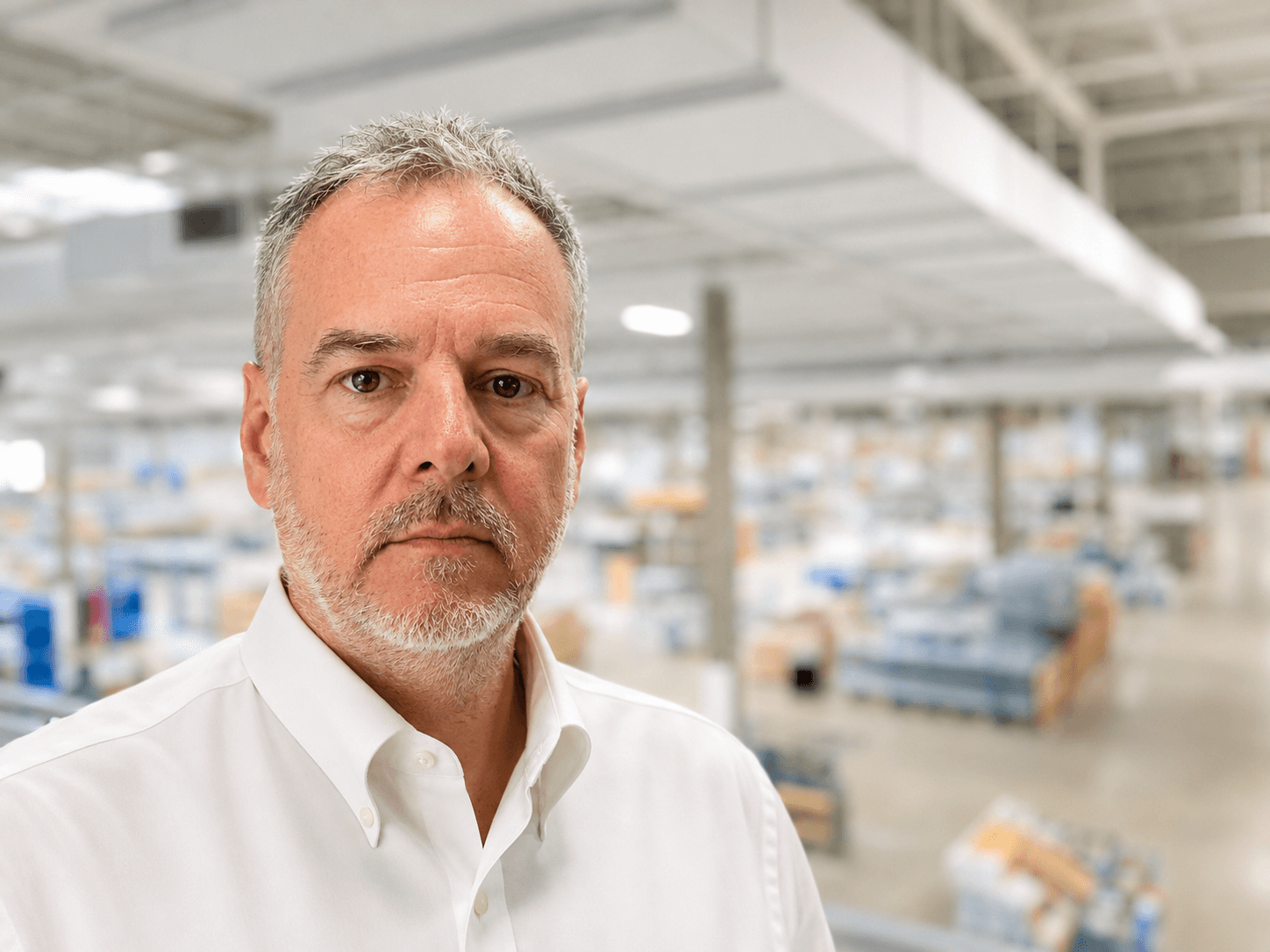
I’ve spent 30 years inside this industry. The mounting room problem was hiding in plain sight.
Flexopodz founder Jim Lawlor on why he built what nobody else had.
On this page
Jim’s story, the operating lesson, and the reason this matters now.
Origin Story
My career started on the vendor side — selling CTP equipment, prepress software, press-side workflow systems, eventually enterprise ERP — to flexographic plants across North America. I walked a lot of floors over those years. Flexible packaging plants, corrugated facilities, label converters, folding carton operations. All sizes. All levels of sophistication.
And I kept seeing the same thing.
A press worth two million dollars, sitting idle at makeready, because somebody was still looking for sleeves. A mounting room that hadn’t been deliberately designed — it had just accumulated. Racks that were never meant to hold what they were holding. Operators who knew where everything was because they’d worked there for fifteen years, and nobody had ever written it down.
The press gets measured. The press gets optimized. The press gets a capital budget and a dedicated improvement program.
The mounting room gets a workaround.
I started Flexopodz in 2019 because I couldn’t find anyone who had built a storage system specifically for this problem. Not a generic industrial rack. Not a repurposed warehouse solution. A system designed around how flexographic sleeves and plates actually move — from storage to mounter to press and back — across two and three shifts, with operators under time pressure and supervisors stretched thin.
The first installation went in the following year. I’ve been refining the approach ever since.
The Inventor’s Instinct
This isn’t the first time I’ve built something the industry didn’t have.
In 2001, I developed the RJD Gravity Stacker — an offset aluminum plate stacker with no moving parts. The mechanical stackers on the market at the time were expensive, maintenance-heavy, and took up floor space plants didn’t have. I took a different approach. Gravity does the work. No motors, no mechanisms, nothing to break. The result was a system that reduced floor space by 80%, cost one-third of its mechanical competitors, and carried a lifetime guarantee.
The industry responded. We sold 3,000 units.
That experience shaped how I think about every problem since.
The best solution is usually the simplest one. The one that’s easy to train, easy to maintain, and doesn’t create a new dependency while solving an old one. Before we fire up the welder and start cutting metal, we look at every possible alternative to create efficiency at scale. Hardware is the last question, not the first.
That’s the philosophy behind Flexopodz. And it’s why the Operational Capacity Evaluation doesn’t name a single product — because the right answer has to be earned by the data, not assumed before we walk in the door.
What I’ve Learned
Three things have stayed consistent across every plant I’ve audited.
01
The cost is bigger than anyone expects.
When we quantify retrieval time, supervisor labor lost to manual scheduling, motion waste, sleeve damage, and safety exposure — and hold every number at its conservative, defensible floor — the annual loss typically runs between $140,000 and $350,000. At plants with underutilized automated mounting equipment, we’ve documented recoverable losses approaching $1,000,000 per year. That capital was already purchased. The floor space was already committed. Recovery was a question of upstream conditions, not new spend.
02
The problem is a system, not a storage issue.
Every plant I’ve audited had tried to solve it by adding racks. None had tried to solve it by redesigning how the whole room works — layout, information flow, retrieval logic, staging sequence, handoff to press. The recoverable value lives in the system. Before we fire up the welder and start cutting metal, we look at every possible alternative to create efficiency at scale. Sometimes the answer is a better system design. Sometimes it’s workflow. Sometimes it’s both. Hardware is the last question, not the first.
03
The safety exposure is real and it’s structural.
In every audit we’ve conducted, there was at least one safety condition that couldn’t be remediated through training or PPE — only through replacing the underlying equipment. In one case, a lost-time injury had already occurred. In two others, near-misses had been reported but not formally documented. Maintenance teams were managing the hazard through workarounds. That’s not a sustainable position.
Why This Matters Now
The mounting room is where the throughput is hiding.
Capital approval cycles for new presses are running 12 to 24 months. Experienced operators are retiring faster than they’re being replaced. EHS scrutiny is increasing at the board level. And every plant I talk to is being asked to find throughput inside existing assets rather than buy more of them.
My job is to find it, put a number on it, and help the team build the case to fix it — with documentation that finance can audit, not a sales pitch they have to take on faith.
That’s what the Mounting Room Report is. That’s what the Operational Capacity Evaluation delivers. And that’s why I built Flexopodz.
I’m happy to talk through what you’re seeing in your operation.
No pitch — just a conversation about what the numbers might look like.